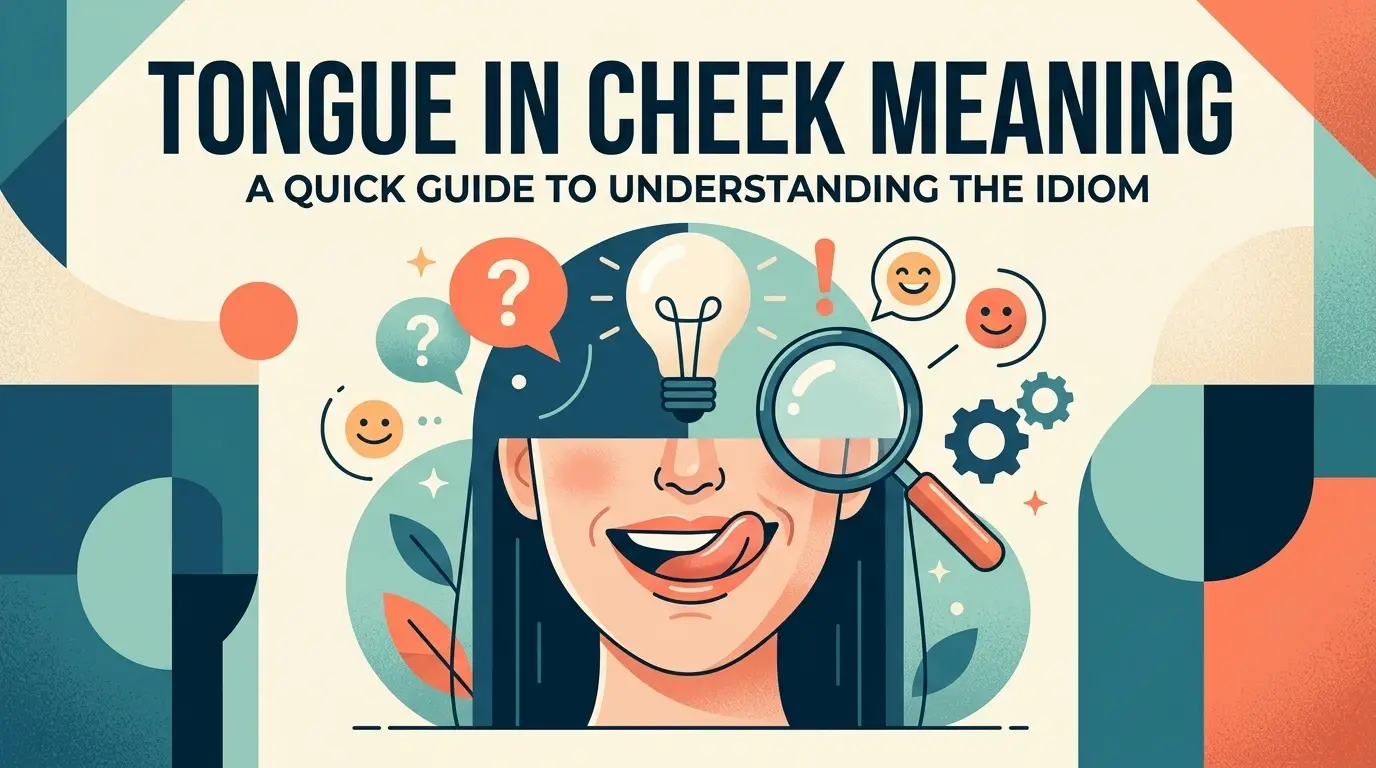
Have you ever received a text that sounded serious, but you felt the person was actually joking? You may have seen someone describe it as tongue in cheek.
For example, a friend may say, “Wow, you are so early today,” when you are only five minutes late. They are not really praising you. They are joking in a playful way.
The tongue in cheek meaning in text is usually a funny or ironic comment that is not meant to be taken seriously. It can sound serious at first, but the real meaning is often humorous.
You may see this phrase in WhatsApp messages, Instagram comments, Snapchat chats, Facebook posts, and other social media conversations. Understanding it can help you know when someone is joking instead of speaking seriously.
Quick Answer: Tongue in Cheek Meaning in Text
Tongue in cheek means making a funny, ironic, or playful statement that is not meant to be taken completely seriously.
It is often used in texts, chats, social media comments, and casual conversations.
What Does “Tongue in Cheek” Mean in Text?
Tongue in cheek means saying something in a joking, ironic, or playful way while pretending to be serious.
In simple words, it means:
“I am saying this, but I do not really mean it seriously.”
The phrase is often used when someone makes a joke that sounds like a real statement.
Simple Example
If your friend eats your last slice of pizza and you say:
“Thank you so much for saving me some pizza!”
That could be a tongue-in-cheek comment because you actually mean the opposite. You are joking about the fact that they ate it all.
Full Form of “Tongue in Cheek”
Tongue in cheek does not have a full form.
It is not an acronym like LOL, BRB, or IDK.
It is an English idiom or expression. The phrase describes a way of speaking that is humorous, ironic, or not completely serious.
The correct spelling is commonly written as:
tongue-in-cheek
It can also appear as:
tongue in cheek
The hyphenated form is often used when it works as an adjective.
Example
- She made a tongue-in-cheek comment.
- His answer was tongue in cheek.
- It was a tongue-in-cheek joke.
How Is “Tongue in Cheek” Used in Chat?
People use tongue in cheek when they want to make a playful or ironic comment.
Here are some natural chat examples.
Example 1
Friend: You are late again.
You: I was only 30 minutes late. Basically, I was early. 😂
This is tongue in cheek because the person is joking about being late.
Example 2
Friend: Did you finish all the work?
You: Of course. I love doing work at 2 AM. 😭
This sounds positive, but the person is actually joking.
Example 3
Friend: You forgot my birthday!
You: No way. I was just testing your memory. 😂
This is a playful excuse and can be called tongue-in-cheek.
What Does “Tongue in Cheek” Mean From a Girl or Boy?
The meaning does not change based on whether a girl or boy says it.
However, the emotional tone can depend on the situation.
Friendly
A person may use tongue-in-cheek humor to tease a friend.
Example:
“Wow, you finally replied after three days. Amazing! 😂”
This is usually friendly teasing.
Flirty
Sometimes it can be used in a playful or flirty conversation.
Example:
“You really think you can ignore me that easily? 😏”
The person may be joking and trying to create a playful mood.
Casual
It is also common in everyday conversations.
Example:
“Sure, I totally enjoy waking up early.”
The speaker may actually dislike waking up early.
Serious Conversation
Tongue-in-cheek comments can sometimes be misunderstood during a serious conversation. Someone may think you are being rude or dismissive if they do not understand the joke.
Is “Tongue in Cheek” Rude or Polite?
Tongue in cheek is not automatically rude or polite.
It depends on the words, situation, and relationship between the people.
Among close friends, it can be funny and harmless.
But it can sound rude when the joke targets someone’s appearance, mistakes, feelings, work, or personal problems.
Friendly Example
“Wow, you are only ten minutes late. What a record! 😂”
This is light teasing.
Potentially Rude Example
“Great job. You finally managed to do something right.”
This could hurt someone’s feelings, even if the speaker claims it was a joke.
Simple Rule
If the other person may feel embarrassed, insulted, or attacked, avoid tongue-in-cheek humor.
When Should You Use “Tongue in Cheek”?
You can use tongue-in-cheek humor in casual conversations when you know the other person will understand your joke.
- When talking with close friends
- In casual WhatsApp chats
- In funny Instagram comments
- When teasing someone playfully
- In relaxed Snapchat conversations
- When making a light joke
- When the situation is not serious
- When both people understand each other’s humor
- When you want to make a boring conversation more fun
- When joking about a harmless situation
When Should You NOT Use “Tongue in Cheek”?
Avoid this type of humor when the situation needs clear and serious communication.
- In a serious work email
- During a job interview
- When giving important instructions
- During an argument
- When someone is upset
- When discussing someone’s personal problems
- When talking about a sensitive topic
- When speaking to someone you do not know well
- In formal business communication
- When your joke could easily be misunderstood
If your message is important, it is usually better to say exactly what you mean.
Best Replies to “Tongue in Cheek” Comments
If someone makes a tongue-in-cheek joke, you can reply in a playful way.
1. “Haha, very funny! 😂”
A simple response when you understand the joke.
2. “Nice one! 😂”
Good for a friendly conversation.
3. “Okay, I see what you did there!”
Use this when you understand the hidden joke.
4. “Very clever! 😄”
A playful reply to a smart or ironic comment.
5. “You’re not fooling me! 😂”
Great when someone is clearly joking with you.
“Tongue in Cheek” Meaning on WhatsApp, Instagram, and Snapchat
The basic meaning of tongue in cheek stays the same across WhatsApp, Instagram, and Snapchat.
It means that someone is making a humorous, ironic, or playful statement rather than speaking completely seriously.
On WhatsApp
A friend may use it while teasing you in a private chat.
Example:
“Sure, I love waiting two hours for your reply. 😂”
On Instagram
It may appear in comments, captions, or replies.
Example:
“Another selfie? We definitely needed one more. 😂”
On Snapchat
It can be used in short messages or playful replies.
Example:
“Wow, you look terrible today. 😜”
If the person is a close friend, the comment may be playful rather than an actual insult.
Does the Meaning Change?
No. The platform does not change the basic meaning.
However, emojis, punctuation, and the relationship between the people can make the joke easier to understand.
How to Know if Someone Is Being Tongue in Cheek
Sometimes it can be hard to tell if a message is serious or sarcastic.
Look for these clues:
- The statement seems obviously exaggerated.
- The person uses laughing emojis.
- The message says the opposite of what happened.
- The person normally jokes with you.
- The situation makes the statement unlikely to be serious.
- The wording sounds playful.
- The person adds 😂, 😆, 😉, or 😜.
- The comment is clearly meant as light teasing.
For example:
“I absolutely love waiting three hours for you.” 😂
The emoji helps show that the speaker is joking.
Tongue in Cheek vs Sarcasm
These terms are related, but they are not always exactly the same.
Tongue in cheek usually describes humor that is playful, ironic, or deliberately not serious.
Sarcasm often involves saying the opposite of what you really mean, sometimes to tease, criticize, or mock someone.
Example of Tongue in Cheek
“Of course I enjoy doing homework on Saturday night.”
The person is joking about homework.
Example of Sarcasm
“Great job!”
Someone might say this after another person makes a mistake.
Sarcasm can be sharper than tongue-in-cheek humor.
Similar Slang Words Like “Tongue in Cheek”
Here are five related terms you may see in online conversations.
1. Sarcastic
A comment that says something different from the speaker’s real meaning, often for humor.
2. Ironic
A situation or statement where the actual meaning is different from what you expect.
3. Joking
Saying something for fun rather than as a serious statement.
4. Teasing
Playfully making fun of someone, usually in a friendly way.
5. Dry Humor
A type of humor delivered in a very serious or calm way.
Is “Tongue in Cheek” the Same as Sarcasm?
Not exactly.
They can overlap, but tongue in cheek is often lighter and more playful.
Sarcasm can sometimes be used to criticize or make fun of someone.
For example:
Tongue in cheek:
“Sure, I have plenty of free time. I only have 20 tasks to finish. 😂”
Sarcasm:
“Wow, excellent timing,” after someone arrives very late.
The exact meaning depends on the context.
FAQs
Is “Tongue in Cheek” Positive or Negative?
It can be either. Most of the time, it is used for playful humor. But it can sound negative if the joke is insulting or hurtful.
Is “Tongue in Cheek” a Slang Word?
Not exactly. It is an English idiom or expression. People often use it in casual conversations and online chats.
Is It Safe to Use With Elders?
It is better to be careful. Older family members may understand the phrase, but a tongue-in-cheek joke can still sound disrespectful in some situations.
Is “Tongue in Cheek” Common in Daily Chat?
Yes. The expression is common in English, especially when talking about jokes, humor, irony, and sarcasm.
Does Tongue in Cheek Mean You Are Lying?
Not necessarily. It usually means the person is joking or being ironic. It is not normally meant as a serious lie.
Can I Use It With Friends?
Yes. It is often used in casual conversations with friends.
Can It Be Flirty?
Yes. Someone may use tongue-in-cheek humor while flirting or teasing. However, the exact meaning depends on the conversation and relationship.
Can Tongue-in-Cheek Be Rude?
Yes. A joke can sound rude if it attacks or embarrasses someone.
What Emoji Goes With Tongue-in-Cheek Humor?
Common choices include 😂, 😆, 😉, 😜, and 😏. But emojis are not required.
What Is the Opposite of Tongue-in-Cheek?
The opposite would be speaking seriously and meaning exactly what you say.
Simple Examples of Tongue-in-Cheek Sentences
Here are some easy examples:
- “I just love being stuck in traffic.”
- “Wow, you replied in only two days. So fast!”
- “Of course I enjoy cleaning my room.”
- “Thanks for eating my lunch. Very kind of you!”
- “I totally needed another Monday.”
- “Sure, because I have nothing else to do.”
- “Amazing. My phone died again. Perfect!”
- “I definitely enjoy waking up at 6 AM.”
- “You are such a helpful friend. You only forgot everything.”
- “What a relaxing day at work!”
These sentences may sound serious at first, but the real meaning is playful or ironic.
Conclusion:
The tongue in cheek meaning in text is simple: it means saying something in a playful or ironic way instead of meaning it completely seriously. It is often used to tease, joke, or make a conversation more fun.
The phrase is not an acronym or traditional slang word. It is an English expression that can appear on WhatsApp, Instagram, Snapchat, and other social platforms.
Remember to check the context before taking a tongue-in-cheek comment seriously. A joke between close friends may sound very different in a formal conversation.
Now you know what tongue in cheek means and how to use it correctly in everyday chat.

I’m Noah Carter, a writer who loves exploring love, relationships, and special moments. Through LoveAnniversarys.com, I share heartfelt stories and tips to make every anniversary unforgettable.